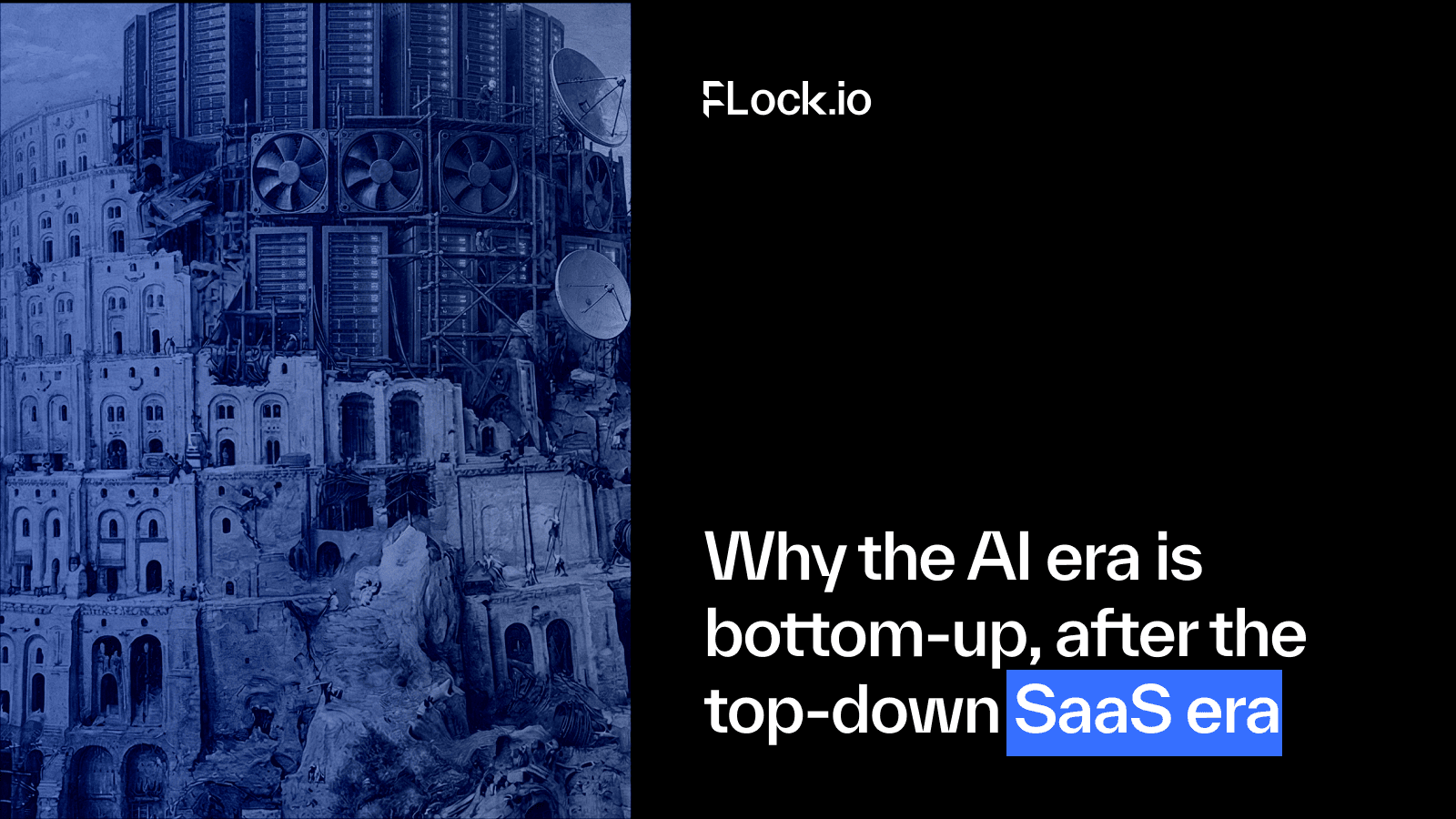
Top-down AI pilots, it turned out, were the completely wrong approach. It was the go-to way for organisations to adopt generative AI after it took off. It mimicked the top-down SaaS era, during which the C-suite selected ready-made tools then rolled them out across departments. But they struggled with adoption, with 95% failing to reach production.
The AI era is bottom-up. To understand what this means, think of when ChatGPT launched: anyone could sign up, and before long enterprises were lining up to buy large-scale, enterprise-wide ChatGPT licenses.
Bottom-up is a radically different strategy and way to adopt technologies. The C-suite knows that employees aren’t waiting around to start using AI. Individuals are already experimenting by solving problems instantly without waiting for IT departments to catch up. The problem is that in the absence of a safe, approved and genuinely useful way to use AI, they are using random tools on their own, creating huge security and compliance risks.
That’s why the bottom-up sales strategy starts by working out the needs of the individual end-users, and then building a solution tailored to that. The executives can define the overall ambition and bigger picture, but they cannot identify the everyday nitty gritty moments where employees could benefit from AI. Involving the employees with the innovation is how to ensure they actually use and benefit from it.
This blog explains how organisations are adapting to the bottom-up AI era, and what FLock.io is doing to help them prepare.
[ 👋 Hi there! If you’re here to find out more about FLock.io, follow us on X and email us at hello@flock.io to learn what we do in distributed inference, federated learning and sovereign AI. See our blogs, research and whitepaper.]
Top-down meant standardised processes, but it was slow to implement
The supposed benefit of the top-down strategy was that processes could be standardised and data storage centralised. But implementation was long: months were spent on procuring the right software, followed by all the IT integration and training. The engineering was expensive and the configuration options were rigid.
Because development cycles were long and expensive, software could only serve, say, 80% of an industry. Then 80% of the companies within it, then 80% of the departments within those. Three 80%s multiplied together add up to a failing grade. It chased breadth over depth and could never be precise.
Bottom-up works to ensure enterprise AI is actually adopted
Top-down AI failed when its strategy was detached from the reality of everyday operations. AI pilots fail to reach production not because the technology is weak, but because it is not properly connected to the business processes. The executive vision is important, but should be combined with teams who are empowered to continuously experiment and shape it for practical use cases. Realising enterprise AI’s potential demands that people trust it and understand how workflows are redesigned around it.
The time and money required to build have dropped sharply, and software now assembles upwards like Lego: first build out one specific customer’s concrete need, then stitch sideways across peers to fill the gaps. This dramatically lifts both efficiency and coverage.
But cost falling to zero doesn’t eliminate the team – it relocates the value. In highly sensitive industries (healthcare, government, finance, legal etc.) the truly expensive and truly hard part was never “writing the software”. It was the work of connecting in: keeping data in-domain, permissions, auditing, liability boundaries, acceptance against business metrics, and ongoing operations. Once “writing” approaches free, “connecting” goes from being hidden to being the only bottleneck – and that is exactly where FLock Tech sits.
FLock.io’s engineers connect AI to business processes
In highly sensitive industries and government settings where data cannot leave its domain, FLock.io is the delivery team that truly connects AI into the business process and answers for the business outcome. We turn the “judgement” accumulated in every on-site engagement into the company’s digital assets (FDA), making our delivery capability replicable and scalable.
Forward deployed engineers (FDEs) are customer-facing software engineers who embed directly inside a client’s team to integrate, customise and deploy software products into production. The FLock.io team’s FDEs go into the client’s environment and do just that. We wire together model capabilities, enterprise data, business systems and frontline workflows, delivering AI applications that are runnable, auditable and continuously iterable. We own the business results after go-live.
FLock.io’s FDEs sit with the people who will use the system, whether surgeons, nurses, lawyers or analysts. They map how a decision actually gets made today. Only then does FLock.io decide what to build, which data to connect and how to measure success.
Three principles never change:
- Data stays in-domain. The raw data, the vertical models trained on it, and the deployed tools and workstreams stay inside the client’s domain and belong to the client.
- Results are accepted against business metrics
- AI provides analysis, assistance and early warning, while the professional retains final judgment.
FLock.io is the underlying supplier to the vertical ecosystem. We provide the horizontal tooling and the FDE methodology so that vertical models across industries don’t each have to build the delivery layer from scratch.
Our method is tried and tested. Examples include colorectal-cancer surgical decision support at a top-tier military hospital; multi-site hemodialysis IDH (intradialytic hypotension) prediction; an AI workbench for a leading law firm; an AI investment-research platform for a brokerage and fund manager; a biopharma micro-peptide design-and-screening platform; and sovereign AI programmes including one for the United Nations Development Programme (UNDP) and one for a Southeast Asian state government (Sarawak, Malaysia).
More about FLock.io
FLock.io is an AI research and infrastructure company pioneering enterprise-grade federated learning and distributed AI solutions. Its decentralised federated learning architecture and production-ready platforms (AI Arena, FL Alliance, FOMO and API Platform) enable organisations to train and deploy their own custom AI models on local hardware while maintaining full data privacy, model ownership, and regulatory alignment by design.
FLock.io has launched its THIS / THAT Model for high-speed, low-cost decision making. Other FLock.io engagements include a biopharma micro-peptide design-and-screening platform, and sovereign AI programmes with the United Nations Development Programme (UNDP) and with the state government of Sarawak, Malaysia.
Recent news developments:
- UNDP and FLock.io strengthen relationship to advance public sector digital innovation in the Dominican Republic
- NHS AI use cases spotlighted by World Economic Forum for work with FLock.io
- FLock.io is the key technical partner in a sovereign AI government initiative for Sarawak
Follow FLock on LinkedIn and X and email the team at hello@flock.io.