Q3 2026 was a period of operational scaling and academic research for FLock.io. Building on the momentum of Q2’s public sector pilots, FLock.io accelerated the real-world deployment of privacy-preserving and sovereign AI systems across enterprise infrastructure public sector institutions.
During this quarter, we expanded our core products, significantly grew our cross-chain liquidity and inference volume, established key partnerships and maintained our research leadership across top tier-one academic conferences.
Key quarterly operational metrics highlight this momentum: 11 research papers accepted across major AI and data mining conferences, and published a further academic paper behind the THIS/THAT Model), over 2.5M decisions processed by the newly launched THIS/THAT Model within its first three weeks and a peak processing volume of 12B tokens in a single seven-day period on the FLock API Platform.
Strategic partnerships & global positioning
FLock.io’s strategic activity in Q3 centred on cloud-native enterprise integrations, solidifying sovereign public-sector agreements and expanding our global validator footprint.
A major milestone was establishing a strategic collaboration with Red Hat to bring FLock.io's federated learning capabilities directly into Red Hat's enterprise ecosystem. Red Hat provides enterprise-grade open -source solutions trusted by more than 90% of Fortune 500 companies, as well as public-sector institutions and government agencies. With this collaboration, FLock.io is working to enable the integration of its enterprise-grade, cloud-native infrastructure with Red Hat’s industry-leading technology stack and broadly adopted by global organisations.
FLock.io also launched its FL Alliance add-on for Open Cluster Management (OCM), an open-source project for managing Kubernetes clusters across hybrid and multi-cloud environments.
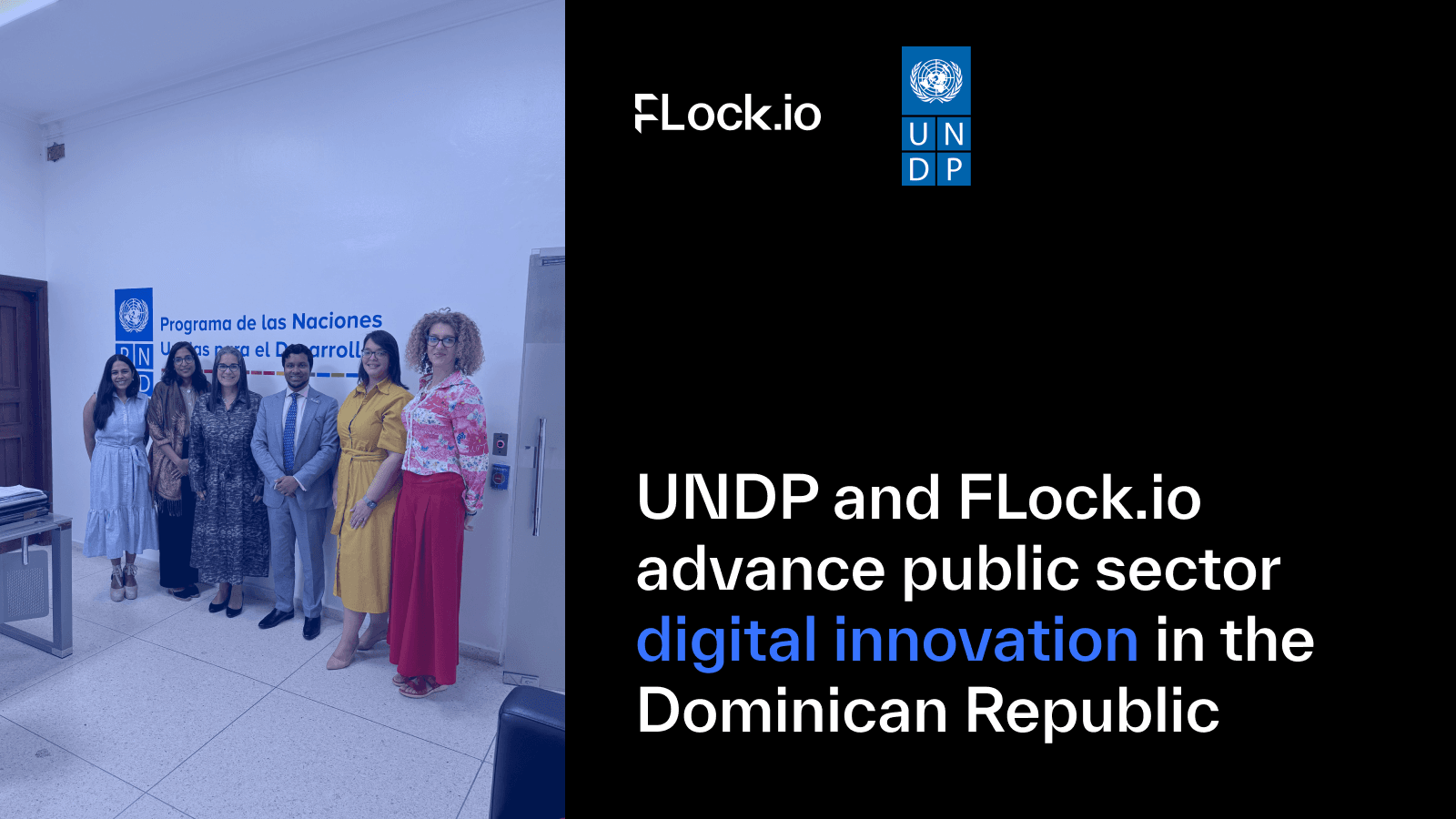
In the public sector, FLock.io and the United Nations Development Programme (UNDP) have strengthened their relationship to advance public sector digital innovation for the Dominican Republic, building on an ongoing pilot this year. They have signed a memorandum of understanding (MoU) to align with the UNDP Strategic Plan (2026–2029) to leverage new technologies for public service delivery and data-driven solutions while striving towards prosperity for all, including climate action and gender equality.
FLock.io also expanded its footprint across Asia. In South Korea, we entered into a strategic partnership with Maekyung Media, one of the region's leading economic media groups, with Maekyung Media and its blockchain arm Mblock Company joining the FLock network as validators. FLock.io also onboarded the Korean Web3 cyber security company ANAM145 as a validator in its network. Additionally, FLock.io is proud to support Tongmyong University's blockchain-powered smart campus initiative, and to support the Busan Municipal Government to deliver privacy-preserving AI infrastructure and technical consultancy for a smart campus in Busan.
These institutional relationships continue to complement our work with international development bodies. The UNDP AltFinLab SDG Blockchain Accelerator progressed into Cohort 3, incorporating AI and decentralised compute alongside blockchain as core technology layers, with FLock.io having served as the strategic AI partner since Cohort 2.

Research & technical leadership
FLock.io's research division delivered a record academic output in Q3, securing 11 paper acceptances across top-tier international conferences:
- CIKM 2026 (6 papers): Focused on decentralised training efficiency and zero-knowledge privacy protection and accepted to a top global information management conference
- ECML PKDD 2026 (3 papers): Investigating fundamental architectural limits and reasoning failure modes in LLMs.
- IEEE ICDM (2 papers): Introducing novel generative modeling architectures for protein dynamics, which is pivotal to drug discovery. The research was done in collaboration with researchers from the University of Oxford and Korea University.
In addition to these 11 papers, the team published the core academic paper detailing the architecture behind the THIS / THAT Model.
At ICPP 2026 in Singapore – a leading venue for parallel and distributed systems – Chief AI Scientist Dr Zehua Cheng presented FLock.io's breakthrough research on learned gradient sketches. By algorithmically predicting and selectively transmitting critical parameter updates rather than full gradient vectors, FLock.io directly addresses the communication bottlenecks inherent to decentralised model training.
Our real-world research applications continued to earn global recognition. FLock.io’s clinical case study on collaborative AI for glucose monitoring through federated learning across NHS trusts was featured in the World Economic Forum (WEF)’s MINDS programme.
Network growth & ecosystem traction
The growth of the FLock.io network in Q3 was marked by expanding cross-chain interoperability, derivative market listings, and developer ecosystem expansion.
In Q3 2026, tokens processed surged from a July baseline of 5.40B across ~451.5k requests to 27.69B in September over 2.75M requests, marking a fivefold increase over the quarter. The platform maintained aggressive month-over-month growth throughout the period, jumping +134.3% in August (12.65B tokens) and another +118.9% in September. This usage was overwhelmingly driven by input volume, which climbed from 4.92B tokens in July to 25.34B in September, reflecting rapid adoption and heavy querying across real-world workloads.
To facilitate seamless cross-chain utility, FLOCK integrated Chainlink’s Cross-Chain Interoperability Protocol (CCIP) to become a Cross-Chain Token accessible across Base, Ethereum, BNB Chain, HyperEVM and Robinhood Chain. Financial infrastructure and token access expanded further with the official launch of $FLOCK perpetual futures on OKX.
Developers and ecosystem builders continued to build on FLock infrastructure across new verticals. In robotics, FLock.io partnered with Fabric Foundation to launch a Vision-Language-Action (VLA) training task on FLock AI Arena, establishing open federated training pipelines for physical AI systems.
Ecosystem outreach was further supported through active developer engagements globally, including workshops at the University of Tokyo, panels at Conviction 2026 in Vietnam, YZ Labs' EASY Residency in Bhutan, and Fotor’s Video Agent launch (where FLock previewed an upcoming AI Arena task for reviewing AI-generated video).

Product & economic innovation
Product engineering in Q3 focused on consumer privacy tools, specialised edge models for autonomous agents, regulatory copilots, and multi-chain inference mechanics.
FLock.io opened the quarter with the release of FLock Chat, a private AI chat interface powered by the FLock API Platform. Engineered with strict privacy defaults—requiring no user login and storing zero chat history on external servers—conversations, files, and context remain entirely localised in the user's browser.
In model development, FLock.io introduced THIS / THAT Model: a 1.88B-parameter open-source decision model built with Alibaba Cloud and Qwen, engineered for ultra-fast decision-making in AI agents and local applications. On our public benchmark, v1.2 scored 87.8% – outperforming Claude Opus 5 and GPT-5.6 while running locally on a laptop GPU – and processed over 2.5 million decisions in its first three weeks. Press coverage included Hackernoon, Business Insider Markets, Korea IT Times and Associated Press.
For capital markets and compliance, FLock.io introduced FilePilot, an AI copilot for regulatory filings co-developed with leading law firms, starting with its RegCA module for US SEC Regulation Crypto Assets filings.
At the economic layer, FLock.io integrated Chainlink CCIP and Transporter, going live on Robinhood Chain, to expand FLOCK token multichain liquidity and secure cross-chain AI infrastructure. Under FOMO's architecture, Model Tokens are valued by real inference usage on the FLock API Platform, allowing users and stakers to convert model operational spending directly into yield.
The FLock API Platform expanded its multi-model gateway by integrating 7 frontier open and vision models: Kimi K3, DeepSeek V4 Flash, V4 Flash Vision Exp, V4.1 Flash, Gemini 3.7 Flash, GLM-5.3, and GLM-5.3-Flash. In late September, platform demand reached a peak of 12 billion tokens processed in seven days.
Institutional recognition & industry visibility
FLock.io maintained a strong presence across sovereign policy forums, international development summits and technical media channels throughout Q3.
CEO Jiahao Sun represented FLock.io at the UN Global Dialogue on AI Governance at UN Geneva, and spoke at a UN briefing on digital assets for sustainable development organised by UNDP, UNCTAD, and ODET in New York. CEO Jiahao Sun also presented on FOMO tokenised AI model economics at NFT NYC.
In government relations, Head of Institutional Development Mo Marikar joined UK MP and Trade Envoy Naz Shah in Kuching for follow-up discussions with Sarawak Premier Abang Johari regarding sovereign AI deployment, progressing the framework established in the Manchester MoU.
This public engagement was paired with regular technical education via the What the FLock.io podcast hosted by our Head of EMEA Tiffany Wang. Q3 episodes covered AI agent security proxies (Carapace), municipal digital twins (Arakon), open bioinformatics skills for AI agents (ClawBio, recognised in Nature) and measurable development outcomes with UNDP AltFinLab.
Outlook – Q4 2026
Looking ahead, Q4 will focus on expanding production deployments of domain-specialised, privacy-first AI models trained directly where sensitive data lives.
General-purpose frontier models will continue to grow in size and capability, but much of the world's most valuable data inside hospitals, municipal councils, financial institutions, and sovereign governments will never be sent to centralized cloud providers. FLock.io will focus on scaling specialised local edge models, operationalising public-sector node infrastructure in the Dominican Republic and Sarawak, expanding enterprise Red Hat integrations, and converting API platform usage into sustained protocol value.
Forward-looking statements
This report contains forward-looking statements regarding our business, strategy, financial condition, and expected future performance. These statements can typically be identified by words such as “may”, “will”, “expect”, “anticipate”, “aim”, “estimate”, “intend”, “plan”, “believe”, “potential”, “continue”, “is/are likely to,” or other similar expressions.
Such statements reflect our management's current expectations and are based on assumptions and information available to us as of the date of this report. They are subject to known and unknown risks, uncertainties, and other factors – many of which are difficult to predict and beyond our control – that could cause our actual results, performance, or achievements to differ materially from those expressed or implied. Accordingly, investors should not place undue reliance on any forward-looking statement.
Except as required by applicable law, we undertake no obligation to update or revise any forward-looking statement, whether as a result of new information, future events or otherwise. This report is provided to investors for informational purposes only and should be read together with our accompanying financial statements and other information we provide.